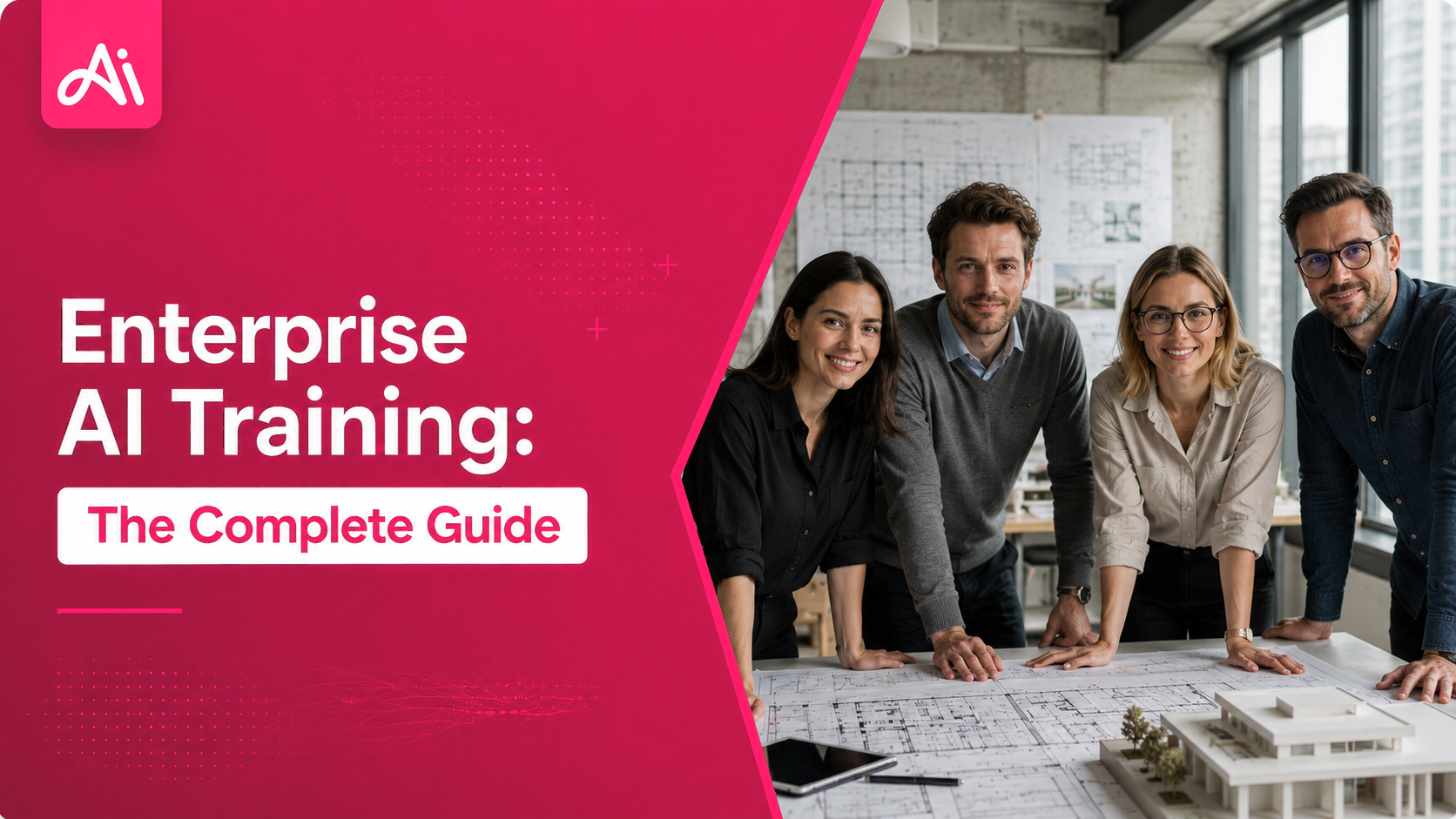
Enterprise AI Training: The Complete Guide
Enterprise AI Training: How to Upskill Your Whole Team (Not Just the Keen Ones)
Most organisations don't have an AI problem. They have an AI training problem.
The licences are bought. The all-staff email has gone out. A handful of enthusiasts are already doing clever things and everyone else tried the chat box once, got a bland answer, and quietly went back to how they did it last year. We've walked into that exact situation in finance teams, professional-services firms, manufacturers, property businesses and construction companies across Ireland and the UK. It's the same story whatever the sector, and it's the reason we do what we do.
This is the version of enterprise AI training we wish more leaders had read before spending the budget. It's built on what we've learned training more than 1,300 professionals across very different industries: what actually changes behaviour, what quietly wastes money, and how to turn "we have Copilot now" into hours saved every single week.
What is enterprise AI training, really?
Enterprise AI training is the structured process of getting an entire organisation - not just its early adopters using AI tools confidently, safely and productively in their real day-to-day work.
That phrase, "real day-to-daywork," is where most programmes live or die. Enterprise AI training is nota webinar about what a large language model is. It's not an hour on the history of ChatGPT. It's sitting with a finance team during month-end and showing them how to draft variance commentary in minutes instead of hours. It's sitting with a bid team on a live tender and cutting the first draft from two days to an afternoon. It's showing a lettings negotiator how to turn a set of property notes into a polished listing without losing their evening. The difference between that and a generic overview is the difference between a programme people forget by Friday and one that changes how the organisation works.
Enterprise AI training vs a one-off workshop
A one-off workshop creates a spike of enthusiasm and almost no lasting change. We know because clients tell us -they'd run the workshop, felt the buzz, and watched usage flatline three weeks later. Enterprise AI training is a rhythm, not an event: hands-on sessions on live work, in-house champions to keep momentum going, and enough follow-up that new habits actually set.
Enterprise AI training vs "just give people ChatGPT"
Handing everyone a licence and hoping is the most expensive way to get nowhere. People default to what they know. Without training that's rooted in their role, most staff use these tools for the occasional email and never touch the workflows where the real hours are hiding. Access is the easy 10%. Adoption is the 90% that pays back.
Why do most enterprise AI training programmes fail?
They fail because they train the tool, not the job.
When you teach "here's how Copilot works," people nod and forget. When you teach "here's how you, as a management accountant, use Copilot to sanity-check a set of figures in ten minutes," it sticks because it solves a problem they had that morning. Across every sector we work in, the same three failure patterns show up:
- No role or industry context. A recruiter, a quantity surveyor and a finance business partner need completely different prompts and examples. Generic training serves none of them well, because none of them can see their own work in it.
- No follow-through. Skills learned on Tuesday die by the following Monday without reinforcement and somewhere to ask questions when they get stuck.
- No permission to change the process. People won't adopt a faster way of working if the surrounding process - and their manager - still rewards the old way. Training has to come with a mandate to actually work differently.
Which teams and industries benefit most from enterprise AI training?
Any team that spends its week reading, writing, summarising, checking or reporting will benefit - which is most of the knowledge economy. The tools earn their keep fastest where documents and repetitive drafting eat the day. Here's where we see the clearest wins, by sector.
Professional services, consulting and finance
Proposal and RFP responses, research synthesis, client reports, board packs, month-end commentary, reconciliations. These teams live in documents and deadlines, and enterprise AI training typically frees up hours a week per person. Finance functions in particular are often surprised how much of month-end reporting is drafting rather than number-crunching and drafting is exactly where AI helps.
Construction, engineering and architecture
Tenders, RFIs, method statements, technical specifications, meeting minutes and reports. Document-heavy processes like tendering are where we've seen completion times roughly halve. For built-environment firms, this is often the fastest, most visible return which is why so much of our work started here.
Property, estate agencies and facilities management
Listing descriptions, market appraisals, client communications, compliance documentation, service reports and SLAs. A lot of this work is high-volume, formulaic writing precisely the kind of task where a well-trained team saves the most time without any drop in quality.
Copilot or Claude: which should you train on first?
For most organisations, the honest answer is both but in different places. Train on Microsoft Copilot first if your teams live inside Microsoft 365 all day, because that's where the fastest everyday wins are: email, Word, Excel, Teams, PowerPoint. Bring in Claude for the deeper reasoning work analysing a long document, interrogating a contract or tender, synthesising research into a considered report.
We go into the trade-offs properly in our Copilot vs Claude comparison and into the specifics of each in our guides to Microsoft Copilot training and Claude AI training for teams. The short version: match the tool to the task, and don't let a"one tool to rule them all" fantasy slow your rollout.
What does good enterprise AI training look like week by week?
Good enterprise AI training follows a rhythm we've refined over hundreds of sessions across very different organisations. It looks less like a course and more like a change programme with a training engine inside it.
Discovery and scoping
Before any training, we map how people actually work -the reporting cycle, the tender process, the version-control headaches, the meetings that eat the week. You can't teach a shortcut to a process you haven't seen, and the shortcuts differ wildly between a housebuilder and an accountancy practice.
Live-project training
Sessions run on real work, not toy examples. A finance team brings a live board pack; a design team brings a live project. People leave with something they used that day, not something they'll "try later."
In-house champions
Every organisation has a few people who take to this quickly. We deliberately build them up as champions so the capability lives in the business after we've gone. Across every rollout we've run, this is the single biggest predictor of whether adoption sticks.
Habit formation and support
New habits need a few weeks of reinforcement. Short follow-ups, a channel for questions, and a light nudge when usage dips. It's unglamorous, and it's where the return on investment actually comes from.
How do you measure ROI from enterprise AI training?
Measure time first, then quality, then confidence. Time is the easiest to see: we typically target 4+ hours saved per person, per week, and in document-heavy teams - tendering, reporting, proposals - we've seen turn around times roughly halve. Track it simply: ask people what they've stopped doing manually and roughly how long it used to take.
Then look at quality (fewer errors, stronger first drafts, more consistent output) and confidence (are people reaching for AI unprompted, across the team, a month later?). If usage is broad and unprompted after a month, you've built capability. If only the original enthusiasts are using it, you've run a workshop.
A quick reality check: if your only metric is "number of people who attended," you're measuring attendance, not adoption. Measure the behaviour that happens the week after the session.
How do you choose an enterprise AI training provider?
Look for three things. First, do they train on your work and your industry, or do they deliver the same generic deck to everyone? Second, do they build internal champions and follow-up, or do they leave after the session and call it done? Third, can they point to real outcomes hours saved, cycle times cut, adoption rates rather than attendance numbers? The right provider treats training as a change programme, not a calendar event, and can speak your sector's language on day one.
What should an enterprise AI training programme include?
A good programme has four layers, built in order. Skipping straight to the clever stuff is why so many fail.
1. Foundations and safe use
Everyone starts here: what these tools are, where they go wrong, and the rules on what data is safe to use. It's short, but it's the difference between confident users and risky ones. We treat this a sits own discipline - see AI literacy training
2. Core role-based skills
The prompts and habits that map to each team's real work - drafting, summarising, checking, analysing. This is the bulk of the value, and it looks completely different for a finance team than for a bid team or a lettings department.
3. Real workflows, not party tricks
Moving from one-off prompts to repeatable workflows: the monthly report, the tender response, the client proposal, the property appraisal. This is where the hours-per-week savings actually come from, because it targets the work people do again and again.
4. Embedding and momentum
Champions, follow-up sessions, a place to ask questions, and light measurement so leaders can see it working. Without this layer, even good training fades.
How long does a programme like this take? For a single team, the core is usually a few weeks - an initial session, a couple of follow-ups, and champions in place. For a whole organisation, it's phased: start with the teams where the return is clearest (often finance, bids or operations), prove it, and roll outward using the champions you've built. Trying to train everyone at once, on day one, is how momentum dies.
What are the most common enterprise AI training mistakes?
These are the expensive ones we're called in to fix, again and again:
- Training everyone the same way. A single generic session for the whole organisation teaches the tool, not the job, and lands with nobody.
- Stopping at the kick-off. No reinforcement means skills fade and only the enthusiasts keep going.
- Ignoring safe use. Skipping data and confidentiality rules turns keen staff into a quiet risk.
- Measuring attendance, not behaviour. A full room tells you nothing about whether anything changed.
- No executive sponsorship. If leaders don't use it and don't back the change, teams read that loud and clear.
None of these are about technology. They're about treating AI adoption as the change programme it actually is.
How long does enterprise AI training take to show ROI?
Most teams see time savings within two to four weeks, because the training runs on live work. We typically target 4+ hours saved per person per week, with the biggest gains in document- and reporting-heavy roles across finance, professional services and the built environment.
Do we train on Copilot or Claude?
Usually both -Copilot for in-flow Microsoft 365 work, Claude for deeper reasoning and long-document analysis. Which comes first depends on your stack; see our Copilot vs Claude comparison
Which industries do you train?
We work across construction, engineering and architecture, plus finance, professional services, manufacturing, property, facilities management, recruitment and marketing. The common factor is document- and knowledge-heavy work, not a specific sector.
Is AI training now a legal requirement?
For many organisations, yes. Under Article 4 of the EU AI Act, deployers must ensure a "sufficient level of AI literacy" among staff using AI on their behalf. We cover what that means in practice in our guide to AI literacy training
Can you train a whole organisation, not just one team?
Yes - that's the point of doing it as a programme. Role and industry-based cohorts plus in-house champions are how you reach everyone, not just the keen early adopters.
Where to start
If you take one thing from this: don't buy more licences and hope. Start by looking honestly at how your teams work and where the hours go, then train on exactly that. That's what we do in a diagnostic and it's the difference between AI being a line item and AI being a habit that compounds across the whole organisation.
Book an AI diagnostic and we'll show you where enterprise AI training would pay back fastest in your business. If you'd rather see the open programmes first, browse our public AI courses.