AI Agents vs Automation: When to Use Which
Ask a room of business leaders what the difference is between an AI agent and automation, and you'll get a dozen answers. It matters, because getting it wrong is expensive: use an agent where simple automation would do and you've over-engineered a solved problem; use rigid automation where you needed an agent and you'll spend months patching a script that keeps breaking. Here's the plain, practical version of AI agents vs automation and how to choose for a real process.
What's the difference between AI agents and automation?
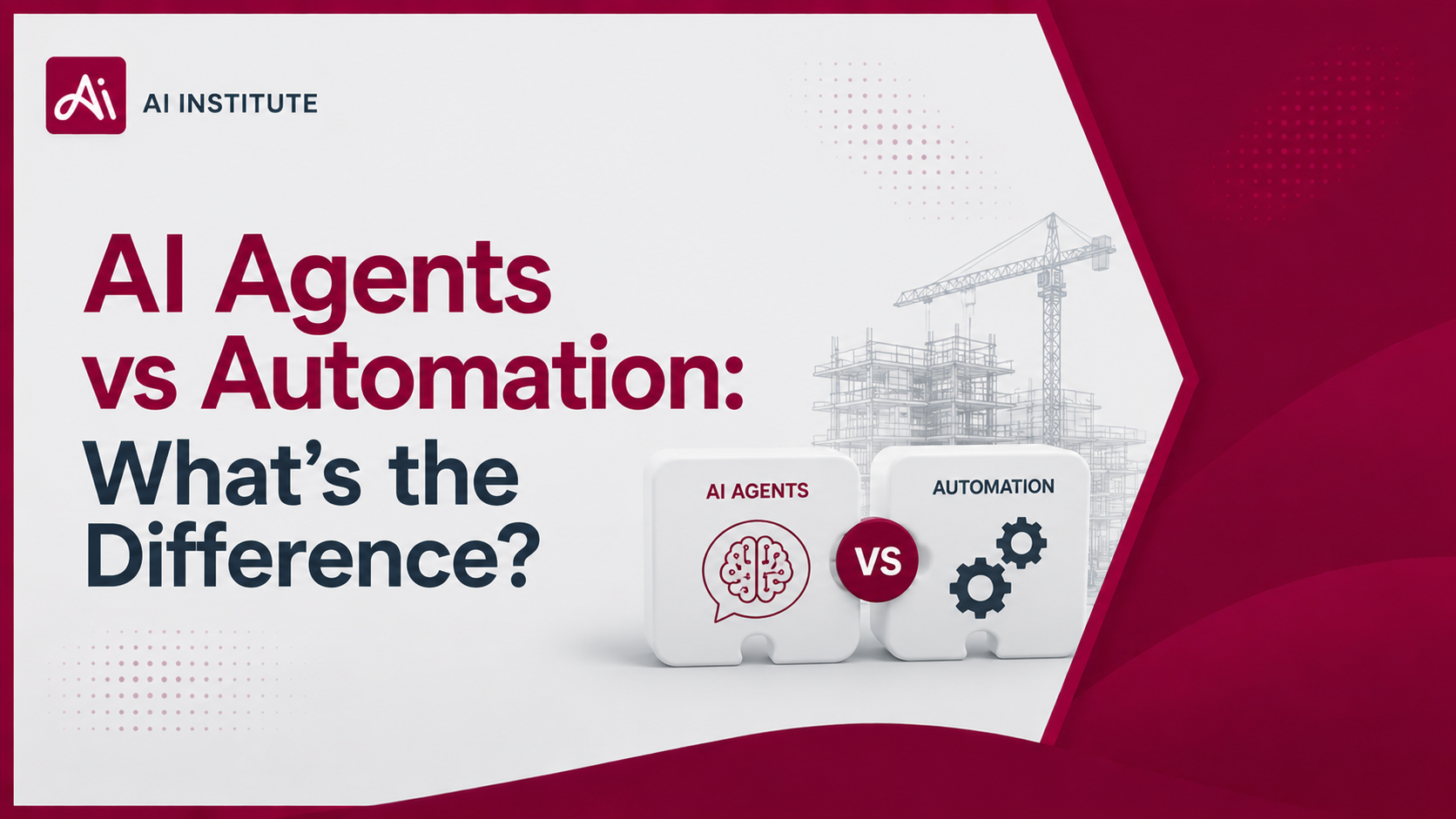
Traditional automation follows a fixed set of rules exactly the same way every time; an AI agent reasons about a task and can adapt across steps, handling variation a fixed rule can't.
A quick illustration. Imagine processing incoming invoices. Automation works brilliantly if every invoice arrives in the same format, in the same place, with the same fields - it applies the rules and never tires. But real invoices arrive as PDFs, emails, scans, in a hundred layouts. That variation is where fixed rules start to fail and where an agent - able to read, interpret and decide earns its place. Automation is a railway; an agent is a driver who can handle a diversion.
When is plain automation the better choice?
Automation wins whenever the work is predictable, high-volume and rules-based. If you can write down the steps completely and they don't change "when a form is submitted, copy these fields into that system and send this confirmation" automation is faster, cheaper, more reliable and easier to audit than an agent. Don't reach for AI to solve a problem a simple workflow already solves. We see organisations spend real money making an "AI" version of something a rules-based automation handled perfectly. If the process is genuinely fixed, keep it fixed.
When do AI agents actually add value?
Agents add value when the task varies enough that fixed rules keep breaking, but it's still repetitive enough to be worth automating. That's the sweet spot: too much variation for a script, too much volume to keep doing by hand.
Real examples across sectors:
- Finance: reading invoices or expenses that arrive in many formats, interpreting them, and drafting the posting forapproval.
- Construction and property: triaging incoming tenders or enquiries that never arrive in a standard shape, and summarising fit.
In each, a rigid rule would fall over on the variation. An agent handles it with a human checking the result.
How do you combine agents and automation?
The best systems use both, and this is the part most "agents vs automation" debates miss. You don't have to choose. The reliable pattern is deterministic automation for the predictable steps and an agent for the step that needs judgement. An invoice process might use automation to move files and send confirmations, and an agent only for the messy "read and interpret this document" step in the middle. Use the agent where you need reasoning, and let dependable automation do everything around it. That combination is usually cheaper, safer and more robust than making an agent do the whole thing.
A simple decision framework: agents or automation?
When you're weighing a specific process, ask three questions:
- Can you write down every step, and do they never change? If yes → automation.
- Does the task vary case to case, but repeat often? If yes → an agent, for the variable part.
- Is a mistake recoverable? If not, keep a human firmly in the loop whichever you choose.
Most real processes are a mix - which is why the answer is so often "automation for the fixed parts, an agent for the judgement, and a person on anything that carries risk." Scoping that correctly is exactly what we do before building anything; it's part of how we work.
What are the most common mistakes?
Two, and they're mirror images. The first is using an agent where automation would do - adding cost, unpredictability and a governance burden to a problem that a simple rule already solved. The second is forcing automation onto a genuinely variable task - building a never-growing pile of rules and exceptions to handle cases a reasoning agent would take in its stride. Both come from deciding the tool before understanding the task. Start with the shape of the process, not the technology you're excited about.
Whichever way you go, if you deploy an agent, govern it from the start - AI agent governance covers how and if you're not sure an agent is even the right call, our Microsoft Copilot agents explainer shows what a realistic first agent looks like. For the wider view of where agents fit in a business, start with our guide to AI agents for business.
AI agents vs RPA: how are they different?
Robotic process automation (RPA) is the automation many organisations already run software "robots" that click through systems following fixed rules, brilliant for repetitive, stable, high-volume tasks. The difference from an AI agent is judgement. RPA does exactly what it's scripted to do and breaks the moment something unexpected appears a new invoice layout, an unhandled exception. An AI agent can reason about that variation and adapt. In practice the two are complementary: RPA for the rigid, repetitive plumbing; an agent for the step that needs interpretation. Some of the strongest systems we see put an agent's judgement inside an RPA process that handles everything around it.
A worked example: an invoice process
Take a finance team processing supplier invoices. A purely automated approach works until invoices arrive inn on-standard formats, at which point exceptions pile up and someone ends up handling them by hand anyway. A purely agent-led approach is overkill for the parts that never change. The sensible design uses both: automation receives the invoice, files it and sends confirmations; an agent reads and interprets the messy document, extracts the details and checks them against the purchase order; and a person approves anything that doesn't match cleanly. The result is faster and more robust than either approach alone and the same pattern transfers to tender triage, enquiry handling and dozens of other processes.
Is an AI agent more expensive than automation?
Usually more expensive to run than a simple rules-based automation, and sometimes cheaper to build for a messy task so cost alone isn't the deciding factor. Fixed automation is cheap and predictable once built, but it gets expensive to maintain when a process keeps throwing exceptions you have to script around. An agent costs more per run but can absorb that variation without constant patching. The honest way to compare is total cost over time, including maintenance not just the build. For a stable process, automation wins on cost; for a genuinely variable one, an agent often wins once you count the hours saved not fixing broken rules.
Are AI agents just fancy automation?
No. Automation follows fixed rules and can't handle variation; agents reason and adapt across steps. They solve different problems, and the best systems use both together.
Which is cheaper and safer?
Automation is more predictable and cheaper for fixed, rules-based work. Agents flex to handle variation but need governance and oversight. Match the tool to the task.
Can you use agents and automation together?
Yes that's usually the best approach. Use dependable automation for predictable steps and an agent only for the step that needs judgement.
How do I choose for my process?
If the steps never change, automate. If the task varies but repeats, use an agent for the variable part. Keep a human on anything where a mistake is costly.
Where to start
Take one process you want to speed up and pull it apart: which steps are fixed, which vary, and where does a mistake hurt? That map tells you where automation fits, where an agent fits, and where a human must stay. It's a far better starting point than picking the technology first.
Map your first use case with us, and we'll tell you honestly whether it needs an agent, automation, or both.